
We all know Anabolic-Androgenic Steroids (AAS) are detrimental to our health in many different ways. However I believe many adverse effects of steroids are not well known and understood, and require further education. One particular AAS with a misunderstood safety profile is Nandrolone (NPP or Deca). Unfortunately the cognitive effects of AAS have been scarcely studied so a lot of understanding come from rodent studies.
Insulin Resistance:
While Nandrolone use can expectedly lead to a decrease in overall fat mass, it does not seem to significantly reduce visceral fat, which is the fat that surrounds the organs and is commonly known as a more problematic type of fat as it is associated with a higher risk of health problems.

Visceral fat surrounding the organs is extremely problematic and can lead to the development of nonalcoholic fatty liver disease. It is estimated 25% of Americans have non alcoholic fatty liver disease. Also certain ethnic groups such as Arabs and North Africans have a strong genetic predisposition to this disease.
Deca lowers overall fat mass, subcutaneous fat, and intramuscular fat. However, it does not decrease visceral fat. This is unusual since other steroids and fasting can reduce visceral fat.
On the topic of Nandrolone’s effect on liver health, it has been shown that Nandrolone use can increase Insulin resistance within the liver, for rats.

Additionally it causes insulin resistance in the muscle over prolonged usage. This is particularly concerning for bodybuilders, as adjunct use of insulin and IGF-1 would have diminishing results after prolonged usage. Therefore, long term use of Nandrolone is likely counterintuitive. Nandrolones effects seem to be a contributor to metabolic dysfunction resembling early diabetes in rodents. Characterised by a reduced ability to store glycogen in muscles and liver, and systemic insulin levels go up, while glucose levels go down.
Insulin resistance may not be a side effect unique to Nandrolone. This line of inquiry has not been well studied, and it is possible many other AAS can contribute to insulin resistance. Keep in mind, the only steroid shown to be beneficial for insulin resistance is Testosterone in a TRT context.
While Nandrolone is an incredible mass builder, the development of insulin resistance can hinder further muscle growth over time. Insulin resistance is a positive feedback loop, and over time will require brute forcing if it continues to develop (more insulin resistance means more use of insulin).
Based on the studies this seems to begin to happen after 3 months of use. This is why I inform my clients that after 3 months (with 6 months being the absolute maximum) they should stop usage.
Its possible that through smart use of metformin, and using a short acting version of Nandrolone you could counteract this affect. SEE CONSULTATIONS. Over time this negative effect of Nandrolone will be detrimental to your body composition.
Androgenicity:
Oftentimes Nandrolone (with Estrogen) is considered a hair safe cycle, and while there is some truth to this because Nandrolone 5 alpha reduces into a less androgenic metabolite, people fail to consider Nandrolone itself is androgenic. Nandrolone itself will certainly cause hair follicle miniaturization, and is often used with Estrogen because Nandrolone scarcely aromatises (~10-20% the rate Testosterone aromatizes) and thus would help the user avoid low estrogen side effects. However there are some issues with the use of exogenous Estrogen. Nandrolone is quite progestogenic, and having estrogenic and progestogenic activity may be responsible for the increase in prolactin seen typically with the Nandrolone and the 19-nor derivatives. The reason being there is some evidence that Prolactin increases with estrogenic and progestogenic activity. This may be why many users in the old bodybuilding forums used to claim that running Trenbolone without any estrogen, including that from a Testosterone base too, may eliminate some of the side effects, however there are obvious issues with that. Whether or not manipulating estrogen would help alleviate prolactin related side effects is just speculation, but clearly Nandrolone is far more problematic than Testosterone usage.
Testosterone paired with a 5 alpha reductase inhibitor is far superior to a Nandrolone only cycle. You will certainly experience far less hair loss and not deal with so many unique side effects.
Depression & Anxiety:
There are a bunch of Neurochemical effects that Nandrolone
In rodent studies there was a reduction of Monoamines in the central nervous system; Serotonin, Noradrenaline, and Dopamine. The reduction in dopamine was in the nucleus accumbens which is the main part of the brain where dopamine is released in response to sweet tastes. This is why you may notice that sweet foods and things like coffee or other “comfort foods” provide less satisfaction when on Nandrolone.

On the topic of Nandrolone and Dopamine specifically, Nandrolone has been shown to downregulate Dopamine D1 receptor, whereas it up-regulated Dopamine D2 receptor in the hypothalamus (nucleus accumbens). Interestingly, the Dopamine D1 receptors promote food intake whereas the Dopamine D2 receptors inhibit food intake, which explains why you may feel appetite suppression on Nandrolone.
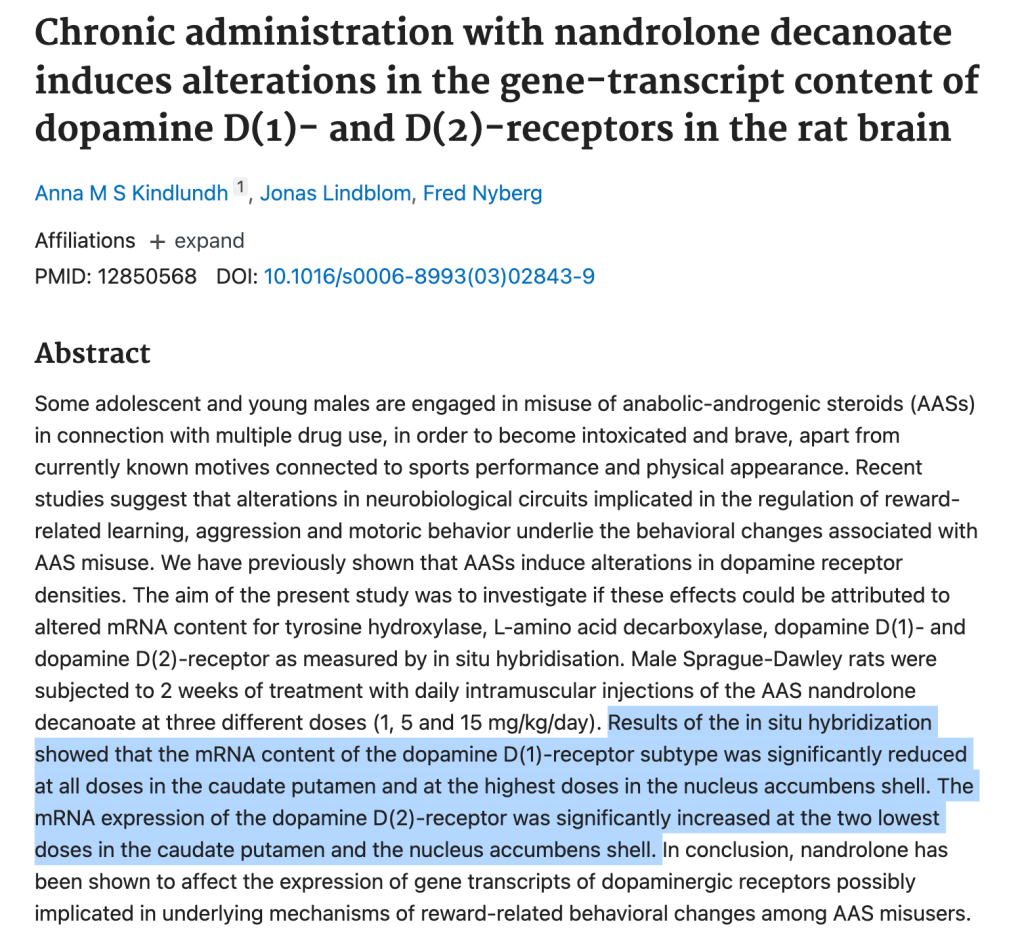
D1 receptors are primarily involved in dopamine signaling, which drives motivation, reward processing, and cognitive function – these processes are all somewhat related to feelings of satisfaction from food. AND, the D2 receptors function as inhibitory autoreceptors, so up-regulation of these receptors may lower dopamine release, which obviously will effect drive and may cause depressive feelings. This effect on the D2 receptors was noted at low doses, so higher doses of Nandrolone may have less of a depressive effect, however will certainly cause more neurodegeneration due to it’s neurotoxic properties.
There are other reasons why Nandrolone may produce a depressive and appetite-suppresive effect in users. Nandrolone lowers neuropeptide Y levels (the target neuropeptide of Ghrelin/MK-677 to stimulate appetite) systemically, which is a neuropeptide with antidepressant effects. This is another reason why you may feel a reduction in appetite and a depressive feeling from Nandrolone.

Also Nandrolone biases the metabolism of tryptophan AWAY from serotonin (and thus Melatonin) production and towards the kynurenine pathway, which produces neural active compounds that are mostly depressive.

This both explains the depressive symptoms of Nandrolone and also insomnia people often experience on Nandrolone and other 19-nor Testosterone derivatives like Trenbolone (“Trensomnia”). This also has implications for neurodegeneration.
There is also some evidence that Nandrolone also interacts with Oxytocin, which I’d speculate happens due to an interaction with the Dopamine-Oxytocin system, however this is not as clear. Nandrolone also lowers Brain Derived Neurotrophic Factor (BDNF) in the brains of rats, which also contributes to depression, but fundamentally can ruin the integrity of your brain over a sustained period.
References:
Zotti M, Tucci P, Colaianna M, Morgese MG, Mhillaj E, Schiavone S, Scaccianoce S, Cuomo V, Trabace L. Chronic nandrolone administration induces dysfunction of the reward pathway in rats. Steroids. 2014 Jan;79:7-13. PMID: 24490270.
Farthing MJ, Green JR, Edwards CR, Dawson AM. Progesterone, prolactin, and gynaecomastia in men with liver disease. Gut. 1982 Apr;23(4):276-9. doi: 10.1136/gut.23.4.276. PMID: 7076004; PMCID: PMC1419724.
Joksimovic J, Selakovic D, Matovic M, Zaletel I, Puskas N, Rosic G. The role of neuropeptide-Y in nandrolone decanoate-induced attenuation of antidepressant effect of exercise. PLoS One. 2017 Jun 5;12(6):e0178922. doi: 10.1371/journal.pone.0178922. PMID: 28582442; PMCID: PMC5459494.
Cattelan Souza L, de Brito MLO, Jesse CR, Boeira SP, de Gomes MG, Goes ATR, Fabbro LD, Machado FR, Prigol M, Nogueira CW. Involvement of kynurenine pathway in depressive-like behaviour induced by nandrolone decanoate in mice. Steroids. 2020 Dec;164:108727. doi: 10.1016/j.steroids.2020.108727. Epub 2020 Sep 4. PMID: 32891681.
 Intelligent Personal Training